
2026 Loan Limits for Manufactured, Modular, and Factory-Built Home Financing
The Manufactured Nationwide Team Offers Non-Conforming Solutions Up to $4.5 Million +
The 2026 baseline conforming loan limit for a manufactured or modular home is $832,750 for a one-unit property in most U.S. counties, and up to $1,249,125 in high-cost areas. The same limits apply to single-section, multi-section, and land-home packages. FHA-insured limits run from a $541,287 floor to a $1,249,125 ceiling. VA-eligible borrowers with full entitlement have no county loan limit at all. Above the conforming limit, qualified borrowers may use in-house jumbo financing, up to $4.5 million on manufactured and modular construction and up to $10 million on an existing modular home, subject to comparable sales and credit approval.
Our team has specialized in manufactured, modular, and factory-built home financing for over a decade. We've helped tens of thousands of buyers across all 50 states secure loans for single-section homes, multi-section properties, land-home packages, and alternative construction methods, including SIP panels, metal frame, ICF, barndominiums, and log homes.
Federal manufactured housing loan limits are set to change. The 21st Century ROAD to Housing Act directs HUD to increase FHA Title I manufactured housing loan limits and lengthen loan terms, though those increases take effect only after HUD completes its rulemaking. The limits below are the limits that apply today. For what is coming and when, read our explainer on the new federal manufactured housing law and FHA Title I loan limits.
Check out our detailed manufactured loan payment and cash to close calculator after you find your max area loan amount.
What the 2026 FHFA Loan Limit Increase Means for Manufactured Home Buyers
The Federal Housing Finance Agency released updated conforming loan limits on November 25, 2025. Starting January 1, 2026, the baseline limit for a one-unit property rises to $832,750, a $26,250 jump from the 2025 figure of $806,500. This 3.26% adjustment reflects FHFA House Price Index data showing continued, though moderating, home price growth.
For manufactured and modular home buyers, these figures determine the maximum loan amount available through conventional financing backed by Fannie Mae and Freddie Mac. Staying within these thresholds typically means access to better interest rates and more straightforward underwriting compared to jumbo loan alternatives.
The practical impact? If you're purchasing a new multi-section manufactured home with land, upgrading to a modular home on acreage, or financing a barndominium or other system-built structure through manufactured home and land construction loans, the higher limits provide additional flexibility. In most counties, $832,750 covers a substantial land-home package with room for site preparation, utility connections, and foundation work.
2026 Conventional Conforming Limits for Manufactured and Modular Homes
Manufactured homes, modular homes, and other factory-built housing follow the same conforming loan limits as traditional site-built properties when financed through conventional programs. The key distinction isn't the limit itself but rather the specific eligibility requirements lenders apply to factory-built structures.
Baseline Limits Applicable to Most Counties
More than 3,000 U.S. counties use these standard figures for 2026:
| Property Configuration | 2026 FHA Floor |
|---|---|
| 1 Unit | $541,287 |
| 2 Units | $693,050 |
| 3 Units | $837,700 |
| 4 Units | $1,041,125 |
Whether you're financing a single-wide, double-wide, triple-wide, or modular home, these baseline figures apply equally. The loan limit doesn't differentiate between a manufactured home and a site-built home as long as the property meets lender and program requirements.
High-Cost County Limits
Approximately 155 counties qualify for elevated limits based on local median home values exceeding 115% of the baseline. The ceiling caps at 150% of the baseline:
| Property Configuration | 2026 High-Cost Ceiling |
|---|---|
| 1 Unit | $1,249,125 |
| 2 Units | $1,599,375 |
| 3 Units | $1,933,200 |
| 4 Units | $2,402,625 |
Buyers placing manufactured or modular homes in markets like coastal California, the New York metro area, or the Washington D.C. region will find their county limits at or near this ceiling. Many counties fall somewhere between baseline and ceiling based on their specific median values.
When loan amounts exceed county conforming limits, borrowers typically move into jumbo financing, where va jumbo loan rates can still remain competitive compared to conventional jumbo options for well-qualified Veterans.
Special Statutory Areas
Alaska, Hawaii, Guam, and the U.S. Virgin Islands receive elevated baseline limits due to higher construction and living costs. For manufactured home buyers in these locations, the numbers provide significantly more financing room:
| Property Configuration | 2026 Baseline | 2026 Ceiling |
|---|---|---|
| 1 Unit | $1,249,125 | $1,873,687 |
| 2 Units | $1,599,375 | $2,399,050 |
| 3 Units | $1,933,200 | $2,899,800 |
| 4 Units | $2,402,625 | $3,603,925 |
2026 Manufactured Home Loan Limits by County
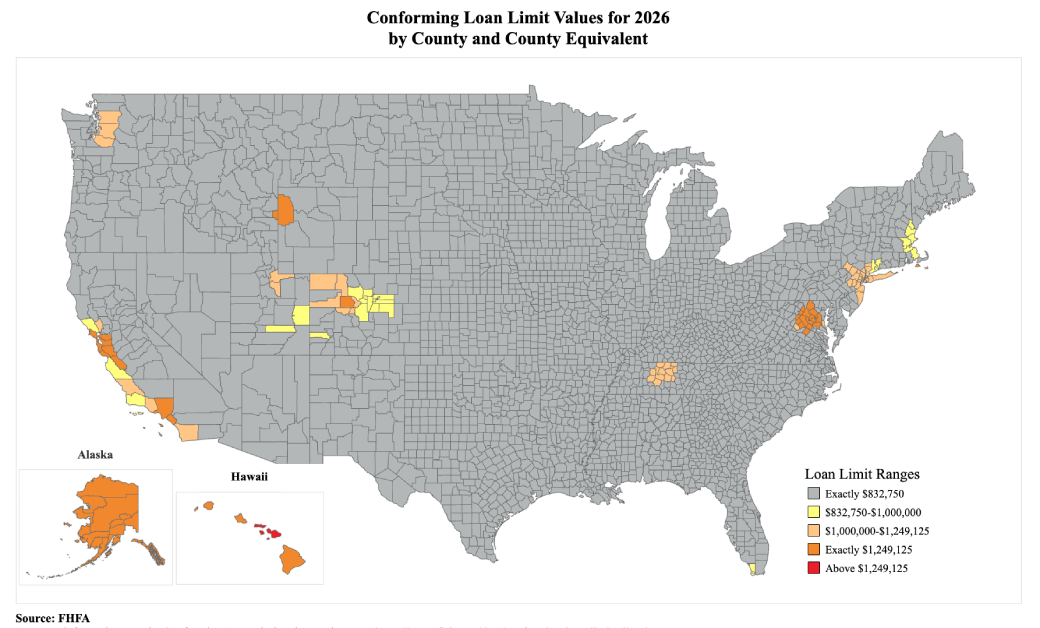
Loan limits are set at the county level, and most of the country uses the same figure. For 2026, more than 3,000 U.S. counties use the baseline conforming limit of $832,750 for a one-unit manufactured or modular home. About 160 counties are designated high-cost and carry limits above the baseline, up to $1,249,125, with special statutory areas in Hawaii reaching $1,299,500.
Use the lookup below to find the 2026 conforming limit for your exact county by state and county.
The figures in the lookup are conforming, or conventional, limits, which apply to manufactured and modular homes financed through Fannie Mae and Freddie Mac. FHA sets its own county limits separately, from a $541,287 floor to a $1,249,125 ceiling, with higher amounts in a smaller set of counties based on local median prices. You can confirm your exact FHA county limit with HUD's official FHA mortgage limits lookup, or review the full county set on the FHFA conforming loan limit page.
For VA-eligible borrowers with full entitlement, there is no county loan limit. When your loan goes above the conforming limit, qualified borrowers may use our in-house jumbo financing, subject to comparable sales and credit approval.
Source: Federal Housing Finance Agency, 2026 Conforming Loan Limit Values, effective January 1, 2026. Figures shown are conforming, or conventional, limits for manufactured and modular homes financed through Fannie Mae and Freddie Mac. Review the full county set on the FHFA conforming loan limit page, or look up your exact FHA county limit with HUD's FHA mortgage limits tool. FHA and VA programs use separate rules described above.
2026 High-Cost Counties Above the $832,750 Baseline
| County | 1 Unit | 2 Units | 3 Units | 4 Units |
|---|---|---|---|---|
| Aleutians East Borough, AK | $1,249,125 | $1,599,375 | $1,933,200 | $2,402,625 |
| Aleutians West Census Area, AK | $1,249,125 | $1,599,375 | $1,933,200 | $2,402,625 |
| Anchorage Municipality, AK | $1,249,125 | $1,599,375 | $1,933,200 | $2,402,625 |
| Bethel Census Area, AK | $1,249,125 | $1,599,375 | $1,933,200 | $2,402,625 |
| Bristol Bay Borough, AK | $1,249,125 | $1,599,375 | $1,933,200 | $2,402,625 |
| Chugach Census Area, AK | $1,249,125 | $1,599,375 | $1,933,200 | $2,402,625 |
| Copper River Census Area, AK | $1,249,125 | $1,599,375 | $1,933,200 | $2,402,625 |
| Denali Borough, AK | $1,249,125 | $1,599,375 | $1,933,200 | $2,402,625 |
| Dillingham Census Area, AK | $1,249,125 | $1,599,375 | $1,933,200 | $2,402,625 |
| Fairbanks North Star Borough, AK | $1,249,125 | $1,599,375 | $1,933,200 | $2,402,625 |
| Haines Borough, AK | $1,249,125 | $1,599,375 | $1,933,200 | $2,402,625 |
| Hoonah-Angoon Census Area, AK | $1,249,125 | $1,599,375 | $1,933,200 | $2,402,625 |
| Juneau City And Borough, AK | $1,249,125 | $1,599,375 | $1,933,200 | $2,402,625 |
| Kenai Peninsula Borough, AK | $1,249,125 | $1,599,375 | $1,933,200 | $2,402,625 |
| Ketchikan Gateway Borough, AK | $1,249,125 | $1,599,375 | $1,933,200 | $2,402,625 |
| Kodiak Island Borough, AK | $1,249,125 | $1,599,375 | $1,933,200 | $2,402,625 |
| Kusilvak Census Area, AK | $1,249,125 | $1,599,375 | $1,933,200 | $2,402,625 |
| Lake And Peninsula Borough, AK | $1,249,125 | $1,599,375 | $1,933,200 | $2,402,625 |
| Matanuska-Susitna Borough, AK | $1,249,125 | $1,599,375 | $1,933,200 | $2,402,625 |
| Nome Census Area, AK | $1,249,125 | $1,599,375 | $1,933,200 | $2,402,625 |
| North Slope Borough, AK | $1,249,125 | $1,599,375 | $1,933,200 | $2,402,625 |
| Northwest Arctic Borough, AK | $1,249,125 | $1,599,375 | $1,933,200 | $2,402,625 |
| Petersburg Census Area, AK | $1,249,125 | $1,599,375 | $1,933,200 | $2,402,625 |
| Prince Of Wales-Hyder Census Area, AK | $1,249,125 | $1,599,375 | $1,933,200 | $2,402,625 |
| Sitka City And Borough, AK | $1,249,125 | $1,599,375 | $1,933,200 | $2,402,625 |
| Skagway Municipality, AK | $1,249,125 | $1,599,375 | $1,933,200 | $2,402,625 |
| Southeast Fairbanks Census Area, AK | $1,249,125 | $1,599,375 | $1,933,200 | $2,402,625 |
| Wrangell City And Borough, AK | $1,249,125 | $1,599,375 | $1,933,200 | $2,402,625 |
| Yakutat City And Borough, AK | $1,249,125 | $1,599,375 | $1,933,200 | $2,402,625 |
| Yukon-Koyukuk Census Area, AK | $1,249,125 | $1,599,375 | $1,933,200 | $2,402,625 |
| Alameda County, CA | $1,249,125 | $1,599,375 | $1,933,200 | $2,402,625 |
| Contra Costa County, CA | $1,249,125 | $1,599,375 | $1,933,200 | $2,402,625 |
| Los Angeles County, CA | $1,249,125 | $1,599,375 | $1,933,200 | $2,402,625 |
| Marin County, CA | $1,249,125 | $1,599,375 | $1,933,200 | $2,402,625 |
| Monterey County, CA | $994,750 | $1,273,450 | $1,539,350 | $1,913,000 |
| Napa County, CA | $1,017,750 | $1,302,900 | $1,574,900 | $1,957,250 |
| Orange County, CA | $1,249,125 | $1,599,375 | $1,933,200 | $2,402,625 |
| San Benito County, CA | $1,249,125 | $1,599,375 | $1,933,200 | $2,402,625 |
| San Diego County, CA | $1,104,000 | $1,413,350 | $1,708,400 | $2,123,100 |
| San Francisco County, CA | $1,249,125 | $1,599,375 | $1,933,200 | $2,402,625 |
| San Luis Obispo County, CA | $1,000,500 | $1,280,850 | $1,548,250 | $1,924,100 |
| San Mateo County, CA | $1,249,125 | $1,599,375 | $1,933,200 | $2,402,625 |
| Santa Barbara County, CA | $941,850 | $1,205,750 | $1,457,450 | $1,811,300 |
| Santa Clara County, CA | $1,249,125 | $1,599,375 | $1,933,200 | $2,402,625 |
| Santa Cruz County, CA | $1,249,125 | $1,599,375 | $1,933,200 | $2,402,625 |
| Sonoma County, CA | $897,000 | $1,148,350 | $1,388,050 | $1,725,050 |
| Ventura County, CA | $1,035,000 | $1,325,000 | $1,601,600 | $1,990,450 |
| Adams County, CO | $862,500 | $1,104,150 | $1,334,700 | $1,658,700 |
| Arapahoe County, CO | $862,500 | $1,104,150 | $1,334,700 | $1,658,700 |
| Boulder County, CO | $879,750 | $1,126,250 | $1,361,350 | $1,691,850 |
| Broomfield County, CO | $862,500 | $1,104,150 | $1,334,700 | $1,658,700 |
| Clear Creek County, CO | $862,500 | $1,104,150 | $1,334,700 | $1,658,700 |
| Denver County, CO | $862,500 | $1,104,150 | $1,334,700 | $1,658,700 |
| Douglas County, CO | $862,500 | $1,104,150 | $1,334,700 | $1,658,700 |
| Eagle County, CO | $1,249,125 | $1,599,375 | $1,933,200 | $2,402,625 |
| Elbert County, CO | $862,500 | $1,104,150 | $1,334,700 | $1,658,700 |
| Garfield County, CO | $1,209,750 | $1,548,975 | $1,872,225 | $2,326,875 |
| Gilpin County, CO | $862,500 | $1,104,150 | $1,334,700 | $1,658,700 |
| Grand County, CO | $883,200 | $1,130,650 | $1,366,700 | $1,698,500 |
| Jefferson County, CO | $862,500 | $1,104,150 | $1,334,700 | $1,658,700 |
| Lake County, CO | $1,092,500 | $1,398,600 | $1,690,600 | $2,101,000 |
| Moffat County, CO | $1,089,050 | $1,394,200 | $1,685,250 | $2,094,350 |
| Park County, CO | $862,500 | $1,104,150 | $1,334,700 | $1,658,700 |
| Pitkin County, CO | $1,209,750 | $1,548,975 | $1,872,225 | $2,326,875 |
| Routt County, CO | $1,089,050 | $1,394,200 | $1,685,250 | $2,094,350 |
| San Miguel County, CO | $994,750 | $1,273,450 | $1,539,350 | $1,913,000 |
| Summit County, CO | $1,092,500 | $1,398,600 | $1,690,600 | $2,101,000 |
| Greater Bridgeport Planning Region, CT | $977,500 | $1,251,400 | $1,512,650 | $1,879,850 |
| Naugatuck Valley Planning Region, CT | $851,000 | $1,089,450 | $1,316,900 | $1,636,550 |
| Western Connecticut Planning Region, CT | $977,500 | $1,251,400 | $1,512,650 | $1,879,850 |
| District Of Columbia, DC | $1,249,125 | $1,599,375 | $1,933,200 | $2,402,625 |
| Monroe County, FL | $990,150 | $1,267,600 | $1,532,200 | $1,904,150 |
| Guam, GU | $1,249,125 | $1,599,375 | $1,933,200 | $2,402,625 |
| Hawaii County, HI | $1,249,125 | $1,599,375 | $1,933,200 | $2,402,625 |
| Honolulu County, HI | $1,249,125 | $1,599,375 | $1,933,200 | $2,402,625 |
| Kalawao County, HI | $1,299,500 | $1,663,600 | $2,010,950 | $2,499,100 |
| Kauai County, HI | $1,249,125 | $1,599,375 | $1,933,200 | $2,402,625 |
| Maui County, HI | $1,299,500 | $1,663,600 | $2,010,950 | $2,499,100 |
| Teton County, ID | $1,249,125 | $1,599,375 | $1,933,200 | $2,402,625 |
| Dukes County, MA | $1,249,125 | $1,599,375 | $1,933,200 | $2,402,625 |
| Essex County, MA | $962,550 | $1,232,250 | $1,489,500 | $1,851,100 |
| Middlesex County, MA | $962,550 | $1,232,250 | $1,489,500 | $1,851,100 |
| Nantucket County, MA | $1,249,125 | $1,599,375 | $1,933,200 | $2,402,625 |
| Norfolk County, MA | $962,550 | $1,232,250 | $1,489,500 | $1,851,100 |
| Plymouth County, MA | $962,550 | $1,232,250 | $1,489,500 | $1,851,100 |
| Suffolk County, MA | $962,550 | $1,232,250 | $1,489,500 | $1,851,100 |
| Calvert County, MD | $1,209,750 | $1,548,975 | $1,872,225 | $2,326,875 |
| Charles County, MD | $1,249,125 | $1,599,375 | $1,933,200 | $2,402,625 |
| Frederick County, MD | $1,249,125 | $1,599,375 | $1,933,200 | $2,402,625 |
| Montgomery County, MD | $1,249,125 | $1,599,375 | $1,933,200 | $2,402,625 |
| Prince George'S County, MD | $1,249,125 | $1,599,375 | $1,933,200 | $2,402,625 |
| Rockingham County, NH | $962,550 | $1,232,250 | $1,489,500 | $1,851,100 |
| Strafford County, NH | $962,550 | $1,232,250 | $1,489,500 | $1,851,100 |
| Bergen County, NJ | $1,209,750 | $1,548,975 | $1,872,225 | $2,326,875 |
| Essex County, NJ | $1,209,750 | $1,548,975 | $1,872,225 | $2,326,875 |
| Hudson County, NJ | $1,209,750 | $1,548,975 | $1,872,225 | $2,326,875 |
| Hunterdon County, NJ | $1,209,750 | $1,548,975 | $1,872,225 | $2,326,875 |
| Middlesex County, NJ | $1,209,750 | $1,548,975 | $1,872,225 | $2,326,875 |
| Monmouth County, NJ | $1,209,750 | $1,548,975 | $1,872,225 | $2,326,875 |
| Morris County, NJ | $1,209,750 | $1,548,975 | $1,872,225 | $2,326,875 |
| Ocean County, NJ | $1,209,750 | $1,548,975 | $1,872,225 | $2,326,875 |
| Passaic County, NJ | $1,209,750 | $1,548,975 | $1,872,225 | $2,326,875 |
| Somerset County, NJ | $1,209,750 | $1,548,975 | $1,872,225 | $2,326,875 |
| Sussex County, NJ | $1,209,750 | $1,548,975 | $1,872,225 | $2,326,875 |
| Union County, NJ | $1,209,750 | $1,548,975 | $1,872,225 | $2,326,875 |
| Bronx County, NY | $1,209,750 | $1,548,975 | $1,872,225 | $2,326,875 |
| Kings County, NY | $1,209,750 | $1,548,975 | $1,872,225 | $2,326,875 |
| Nassau County, NY | $1,209,750 | $1,548,975 | $1,872,225 | $2,326,875 |
| New York County, NY | $1,209,750 | $1,548,975 | $1,872,225 | $2,326,875 |
| Putnam County, NY | $1,209,750 | $1,548,975 | $1,872,225 | $2,326,875 |
| Queens County, NY | $1,209,750 | $1,548,975 | $1,872,225 | $2,326,875 |
| Richmond County, NY | $1,209,750 | $1,548,975 | $1,872,225 | $2,326,875 |
| Rockland County, NY | $1,209,750 | $1,548,975 | $1,872,225 | $2,326,875 |
| Suffolk County, NY | $1,209,750 | $1,548,975 | $1,872,225 | $2,326,875 |
| Westchester County, NY | $1,209,750 | $1,548,975 | $1,872,225 | $2,326,875 |
| Pike County, PA | $1,209,750 | $1,548,975 | $1,872,225 | $2,326,875 |
| Cannon County, TN | $1,029,250 | $1,317,650 | $1,592,700 | $1,979,350 |
| Cheatham County, TN | $1,029,250 | $1,317,650 | $1,592,700 | $1,979,350 |
| Davidson County, TN | $1,029,250 | $1,317,650 | $1,592,700 | $1,979,350 |
| Dickson County, TN | $1,029,250 | $1,317,650 | $1,592,700 | $1,979,350 |
| Hickman County, TN | $1,029,250 | $1,317,650 | $1,592,700 | $1,979,350 |
| Macon County, TN | $1,029,250 | $1,317,650 | $1,592,700 | $1,979,350 |
| Maury County, TN | $1,029,250 | $1,317,650 | $1,592,700 | $1,979,350 |
| Robertson County, TN | $1,029,250 | $1,317,650 | $1,592,700 | $1,979,350 |
| Rutherford County, TN | $1,029,250 | $1,317,650 | $1,592,700 | $1,979,350 |
| Smith County, TN | $1,029,250 | $1,317,650 | $1,592,700 | $1,979,350 |
| Sumner County, TN | $1,029,250 | $1,317,650 | $1,592,700 | $1,979,350 |
| Trousdale County, TN | $1,029,250 | $1,317,650 | $1,592,700 | $1,979,350 |
| Williamson County, TN | $1,029,250 | $1,317,650 | $1,592,700 | $1,979,350 |
| Wilson County, TN | $1,029,250 | $1,317,650 | $1,592,700 | $1,979,350 |
| Grand County, UT | $839,500 | $1,074,700 | $1,299,100 | $1,614,450 |
| Summit County, UT | $1,150,000 | $1,472,250 | $1,779,600 | $2,211,600 |
| Wasatch County, UT | $1,150,000 | $1,472,250 | $1,779,600 | $2,211,600 |
| Wayne County, UT | $997,050 | $1,276,400 | $1,542,900 | $1,917,450 |
| Alexandria City, VA | $1,249,125 | $1,599,375 | $1,933,200 | $2,402,625 |
| Arlington County, VA | $1,249,125 | $1,599,375 | $1,933,200 | $2,402,625 |
| Clarke County, VA | $1,249,125 | $1,599,375 | $1,933,200 | $2,402,625 |
| Culpeper County, VA | $1,249,125 | $1,599,375 | $1,933,200 | $2,402,625 |
| Fairfax City, VA | $1,249,125 | $1,599,375 | $1,933,200 | $2,402,625 |
| Fairfax County, VA | $1,249,125 | $1,599,375 | $1,933,200 | $2,402,625 |
| Falls Church City, VA | $1,249,125 | $1,599,375 | $1,933,200 | $2,402,625 |
| Fauquier County, VA | $1,249,125 | $1,599,375 | $1,933,200 | $2,402,625 |
| Fredericksburg City, VA | $1,249,125 | $1,599,375 | $1,933,200 | $2,402,625 |
| Loudoun County, VA | $1,249,125 | $1,599,375 | $1,933,200 | $2,402,625 |
| Madison County, VA | $1,209,750 | $1,548,975 | $1,872,225 | $2,326,875 |
| Manassas City, VA | $1,249,125 | $1,599,375 | $1,933,200 | $2,402,625 |
| Manassas Park City, VA | $1,249,125 | $1,599,375 | $1,933,200 | $2,402,625 |
| Prince William County, VA | $1,249,125 | $1,599,375 | $1,933,200 | $2,402,625 |
| Rappahannock County, VA | $1,249,125 | $1,599,375 | $1,933,200 | $2,402,625 |
| Spotsylvania County, VA | $1,249,125 | $1,599,375 | $1,933,200 | $2,402,625 |
| Stafford County, VA | $1,249,125 | $1,599,375 | $1,933,200 | $2,402,625 |
| Warren County, VA | $1,249,125 | $1,599,375 | $1,933,200 | $2,402,625 |
| St. Croix Island, VI | $1,249,125 | $1,599,375 | $1,933,200 | $2,402,625 |
| St. John Island, VI | $1,249,125 | $1,599,375 | $1,933,200 | $2,402,625 |
| St. Thomas Island, VI | $1,249,125 | $1,599,375 | $1,933,200 | $2,402,625 |
| King County, WA | $1,063,750 | $1,361,800 | $1,646,100 | $2,045,700 |
| Pierce County, WA | $1,063,750 | $1,361,800 | $1,646,100 | $2,045,700 |
| Snohomish County, WA | $1,063,750 | $1,361,800 | $1,646,100 | $2,045,700 |
| Jefferson County, WV | $1,249,125 | $1,599,375 | $1,933,200 | $2,402,625 |
| Teton County, WY | $1,249,125 | $1,599,375 | $1,933,200 | $2,402,625 |
FHA Financing Options for Manufactured Housing in 2026
FHA loans remain one of the most accessible paths to manufactured home ownership, particularly for buyers with moderate down payments or credit profiles that don't fit conventional guidelines. Two distinct FHA programs serve manufactured housing: Title II (real property loans) and Title I (chattel and combination loans).
FHA Title II Loan Limits
Title II FHA loans treat manufactured homes as real property, requiring the home to be permanently affixed to land the borrower owns. These limits are calculated as percentages of the FHFA conforming figures.
FHA Floor (Low-Cost Areas):
| Property Configuration | 2026 FHA Floor |
|---|---|
| 1 Unit | $541,288 |
| 2 Units | $693,063 |
| 3 Units | $837,720 |
| 4 Units | $1,041,138 |
FHA Ceiling (High-Cost Areas):
| Property Configuration | 2026 FHA Ceiling |
|---|---|
| 1 Unit | $1,249,125 |
| 2 Units | $1,599,375 |
| 3 Units | $1,933,200 |
| 4 Units | $2,402,625 |
FHA Special Exception Areas (Alaska, Hawaii, Guam, U.S. Virgin Islands):
| Property Configuration | 2026 FHA Special Area Limit |
|---|---|
| 1 Unit | $1,873,687 |
| 2 Units | $2,399,050 |
| 3 Units | $2,899,800 |
| 4 Units | $3,603,925 |
For buyers considering an FHA loan for a manufactured home purchase already fixed to land you would own, the FHA manufactured home loan page provides detailed eligibility requirements and program options.
FHA Title I Manufactured Home Loan Limits
Title I loans offer a distinct path for manufactured home financing, particularly useful when the home will not be classified as real property or when land is leased rather than owned. These limits are set separately by HUD and updated periodically.
2025 Title I Limits (Current Reference):
| Loan Type | 2025 Limit |
|---|---|
| Single-Section Home Only | $105,532 |
| Multi-Section Home Only | $193,719 |
| Lot Only | $43,377 |
| Combination (Single-Section + Lot) | $148,909 |
| Combination (Multi-Section + Lot) | $237,096 |
Note: Official 2026 FHA Title I limits have not yet been released as of this writing. HUD typically announces updated Title I figures in conjunction with their annual limit adjustments. Based on historical patterns and the 3.26% conforming limit increase, 2026 Title I limits are expected to rise accordingly. Contact our team or check HUD's official resources for the most current figures.
How VA and USDA Programs Work Differently
While this page focuses primarily on conventional and FHA loan limits, two other major programs serve manufactured home buyers with distinct approaches.
VA Loans for Manufactured Homes
Veterans and eligible service members can finance manufactured homes through VA loan programs. Since the Blue Water Navy Vietnam Veterans Act took effect in January 2020, VA loans no longer impose a strict maximum for borrowers with full entitlement. A veteran with complete entitlement available can finance a manufactured home above any county limit with zero down payment, provided they meet lender qualification standards.
Veterans with partial entitlement (those with existing VA loans or entitlement affected by previous transactions) may still reference county conforming limits when calculating available benefits. Manufactured homes financed through VA must meet specific requirements outlined by the Department of Veterans Affairs, including foundation certification and property standards. Our VA standards for manufactured homes page details these requirements.
| Entitlement Status | 2026 Loan Limit | Down Payment |
|---|---|---|
| Full entitlement | No county loan limit. You may finance above any county figure. | $0 down for qualified borrowers, up to the appraised value and lender qualification. |
| Partial entitlement | References the county conforming limit, $832,750 baseline and up to $1,249,125 in high-cost areas. | May require a down payment on the portion above your remaining entitlement. |
Since the Blue Water Navy Vietnam Veterans Act took effect in January 2020, VA loans no longer impose a county loan limit for borrowers with full entitlement. A Veteran with complete entitlement available can finance a manufactured or modular home above any county figure with zero down for qualified borrowers, provided the file meets lender and property standards. Veterans with partial entitlement, meaning an existing VA loan or entitlement tied up in a prior transaction, may still reference the county conforming limits above when calculating the benefit available. Manufactured homes financed through VA must meet the foundation certification and property requirements set by the Department of Veterans Affairs, which our team handles in-house. Our VA standards for manufactured homes page details every requirement.
USDA Rural Development Loans
USDA financing operates under different parameters entirely. Rather than county-based loan limits like conventional or FHA programs, USDA eligibility depends primarily on household income (typically capped at 115% of area median income), debt-to-income ratios, and property location in USDA-designated rural areas.
For manufactured homes, USDA requires the unit to be new, permanently affixed to a foundation, and located in an eligible area. The program does not use the same limit structure as conventional financing, so the figures on this page serve only as general market references for USDA borrowers rather than direct program caps.
Jumbo and Non-Conforming Manufactured Home Financing
Loan limits set the maximum you can borrow through conforming and FHA programs, but they are not the end of the road when your project runs higher. Two paths finance a manufactured or modular home above the county conforming limit, an in-house jumbo loan, or VA financing for a Veteran with full entitlement.
Manufactured and Modular Jumbo Loans Up to $4.5 Million
| Program | In-House Jumbo Ceiling |
|---|---|
| Manufactured home, purchase or construction | Up to $4.5 million |
| Modular home, construction | Up to $4.5 million |
| Modular home, already built | Up to $10 million |
Jumbo and non-conforming amounts are for qualified borrowers, subject to comparable sales and credit approval. Our land cap is 30 acres, so most manufactured and modular requests fall well under these ceilings.
When your total loan amount goes above your county conforming limit, the loan becomes a jumbo, or non-conforming, loan. Most lenders will not write a jumbo on a manufactured home at all. We underwrite them in-house on our own portfolio programs. For manufactured homes and modular construction, we lend up to $4.5 million for qualified borrowers.
On an existing modular home, meaning one already built, we lend up to $10 million. In every case the finished home has to support the value with comparable sales.
Jumbo files generally call for a stronger credit profile, a larger down payment, and fuller documentation than a conforming loan, and rates may differ from conforming rates. Because we keep the loan in-house rather than selling it, we can go over the standard county limits on scenarios that fit our guidelines.
Our land cap is 30 acres, so most manufactured and modular jumbo requests fall well under the ceiling unless approved for a land size exception under our in-house loan comitte. Qualification is subject to credit approval.
VA No-Limit Financing for Full-Entitlement Veterans
A Veteran with full entitlement has no county loan limit on a VA loan, which is a separate benefit from conventional jumbo financing. An eligible Veteran can finance a manufactured or modular home above the county conforming figure with zero down for qualified borrowers, provided the file meets lender and property standards.
This is one of the strongest ways to finance a higher-value factory-built home, since there is no monthly mortgage insurance on a VA loan and no county ceiling to work around.
Veterans with partial entitlement can still use the benefit, though the county conforming limits above become the reference point for the portion financed with entitlement. See the VA section earlier on this page and our VA standards for manufactured homes page for the property and foundation requirements.
Manufactured Home Financing Requirements Beyond Loan Limits
Loan limits represent just one piece of the manufactured home financing puzzle. County loan limits define how much you may be eligible to borrow, but approval ultimately depends on whether a lender actively finances manufactured homes under the specific program, property type, and loan amount you need. Many buyers lose time working with banks that technically follow loan limits but lack manufactured housing expertise. To avoid that mistake, review this guide comparing the top manufactured home lenders before you apply. Several additional factors determine whether a property qualifies for conventional or FHA financing:
HUD Certification: Manufactured homes must carry a HUD certification label indicating they were built after June 15, 1976, when federal construction standards took effect. Homes built before this date are classified as mobile homes and generally cannot be financed through conventional or FHA programs.
Foundation Requirements: Most loan programs require manufactured homes to be permanently affixed to a foundation meeting HUD, FHA, or VA engineering standards. Foundation certification from a licensed engineer is typically required at closing.
Age Restrictions: Lenders often impose age limits on manufactured homes, commonly 15 to 20 years depending on the program and property condition. Newer homes generally qualify for better terms.
Land Ownership vs. Leased Land: Conventional and FHA Title II loans require the borrower to own the land (or finance land and home together). Homes on leased lots typically require chattel financing or FHA Title I loans, which carry different terms and limits.
Property Classification: How your county classifies the property (real property vs. personal property) affects financing options, title insurance, and tax treatment. Converting a manufactured home to real property often requires specific documentation and may involve working with local assessors.
For buyers navigating these requirements, our manufactured home loan options page breaks down program eligibility across conventional, FHA, VA, and alternative financing paths.
Year-Over-Year Loan Limit Progression (2023-2026)
Tracking conforming limit changes provides context for market trends and helps manufactured home buyers understand how purchasing power has shifted.
| Year | 1-Unit Baseline | 1-Unit High-Cost Ceiling | Annual Change |
|---|---|---|---|
| 2023 | $726,200 | $1,089,300 | Baseline year |
| 2024 | $766,550 | $1,149,825 | +5.56% |
| 2025 | $806,500 | $1,209,750 | +5.21% |
| 2026 | $832,750 | $1,249,125 | +3.26% |
The 3.26% increase for 2026 marks a slower pace compared to the previous two years, reflecting moderating home price appreciation in the FHFA House Price Index. For manufactured home buyers, this stability suggests a market that's growing sustainably rather than overheating.
Multi-Unit Baseline Progression (2024-2026):
| Year | 1 Unit | 2 Units | 3 Units | 4 Units |
|---|---|---|---|---|
| 2024 | $766,550 | $981,500 | $1,186,350 | $1,474,400 |
| 2025 | $806,500 | $1,033,000 | $1,248,150 | $1,551,250 |
| 2026 | $832,750 | $1,066,250 | $1,288,800 | $1,601,750 |
Frequently Asked Questions
What are the 2026 conforming loan limits for manufactured homes?
The 2026 baseline conforming loan limit is $832,750 for a one-unit property, including manufactured and modular homes. This figure applies to the majority of U.S. counties. High-cost areas can reach up to $1,249,125, while special statutory areas (Alaska, Hawaii, Guam, U.S. Virgin Islands) start at $1,249,125 and can reach $1,873,675. Multi-section manufactured homes, single-section homes, and land-home packages all fall under these same limits as long as the property meets lender requirements.
Do loan limits differ between single-wide and double-wide manufactured homes?
No. The conforming loan limits apply equally regardless of whether you're financing a single-section (single-wide), multi-section (double-wide or triple-wide), or modular home. The limit is based on property type (one-unit, two-unit, etc.) and county location, not the specific construction configuration of the manufactured home.
What FHA loan limits apply to manufactured homes in 2026?
FHA Title II loan limits for manufactured homes range from $541,287 (the floor in low-cost areas) to $1,249,125 (the ceiling in high-cost areas) for one-unit properties in 2026. FHA Title I limits, which apply to chattel loans and certain combination loans, are set separately by HUD. The 2025 Title I limits range from $105,532 for single-section home-only loans to $237,096 for multi-section combination loans. Updated 2026 Title I figures will be announced by HUD.
Can I finance a barndominium or other system-built home with these limits?
Yes. Alternative construction methods including barndominiums, SIP panel homes, metal frame structures, ICF construction, and log homes can typically be financed under conventional or FHA programs when they meet lender requirements. The same conforming limits apply. Our construction loan page covers financing options for these alternative building methods.
What happens if my manufactured home purchase exceeds the county loan limit?
When your total loan amount exceeds your county's conforming limit, you may need jumbo financing. Jumbo loans for manufactured homes typically require larger down payments, higher credit scores, and more extensive documentation, and interest rates may differ from conforming rates. Manufactured Nationwide underwrites jumbo and non-conforming loans in-house, up to $4.5 million on manufactured homes and modular construction and up to $10 million on existing modular homes, for qualified borrowers, subject to comparable sales and credit approval.
Do VA loans have limits for manufactured home purchases?
For veterans with full entitlement, VA loans have no maximum limit. The Blue Water Navy Vietnam Veterans Act eliminated loan caps for eligible veterans with complete entitlement available. Veterans with partial entitlement may reference county conforming limits when calculating their available benefit. Manufactured homes financed through VA must meet specific property and foundation standards.
How do USDA loans work for manufactured homes?
USDA Rural Development loans use income-based qualification rather than county loan limits. Eligibility depends on household income (typically 115% of area median income or below), debt ratios, and property location in a USDA-designated rural area. Manufactured homes must be new and permanently affixed. The conforming limits on this page don't directly cap USDA financing.
When do the 2026 loan limits take effect?
The 2026 conforming loan limits take effect January 1, 2026. Loans closing in late December 2025 would typically fall under 2025 limits unless delivery to Fannie Mae or Freddie Mac occurs in 2026.
Can loan limits decrease in future years?
No. Under the Housing and Economic Recovery Act of 2008, conforming loan limits cannot decrease. If home prices decline, limits remain flat until appreciation exceeds previous peaks. This protection applies at both the national and county level.
How can I find my specific county's loan limit?
The FHFA publishes a complete county-by-county lookup table each November. You can access the official 2026 limits through the FHFA Conforming Loan Limit page. Our team can also help you identify your county's specific limit during the pre-qualification process.
Start Your Manufactured Home Financing
The 2026 loan limits open doors for manufactured, modular, and factory-built home buyers across the country. Whether you're purchasing a new double-wide on acreage, building a barndominium, financing a modular home package, or exploring cash-out refinancing on your existing manufactured home, understanding these figures helps you plan effectively.
Manufactured Nationwide specializes in the unique aspects of factory-built home financing. Our team understands foundation requirements, title considerations, program eligibility nuances, and the differences between conventional, FHA, VA, and alternative lending paths. When your needs exceed conforming limits, we offer cash-out and non-conforming options up to $4.5 million on manufactured and modular homes, and up to $10 million on existing modular homes, for qualified borrowers.
Ready to explore your options? Use our eligibility quiz to get started, or call us directly at 844-999-0639 to speak with a manufactured home loan specialist. Loan limits and program guidelines are subject to change, so working with a team that focuses specifically on manufactured housing ensures you have accurate, current information for your situation.







Sources and Official References
The loan limit figures on this page are sourced from official government publications:
Federal Housing Finance Agency (FHFA), "Conforming Loan Limit Values for 2026," published November 25, 2025. Available at fhfa.gov/CLL
FHFA 2026 Conforming Loan Limit Addendum (calculation methodology)
FHFA Conforming Loan Limit FAQs
FHA loan limits are calculated based on HUD guidelines using 65% of the conforming baseline for floors and 150% for ceilings. Official FHA limits are published by the Department of Housing and Urban Development.
FHA Title I manufactured home loan information is available through HUD's Title I program page
Manufactured Housing Institute (MHI) provides industry resources at manufacturedhousing.org
Disclaimer: The figures on this page reflect FHFA's November 2025 announcement for 2026 conforming loan limits. FHA Title I limits shown are 2025 figures pending HUD's 2026 announcement. Specific county limits and program details may vary. Manufactured home financing involves additional requirements beyond loan limits. Always verify current guidelines with your loan officer, as program rules and lender overlays can change.
About Manufactured Nationwide Home Loans
Manufactured Nationwide Home Loans, powered by The Federal Savings Bank (NMLS# 411500), specializes in financing for manufactured homes, modular homes, and alternative construction, including SIP panels, metal frame, ICF, barndominiums, and log/timber homes. Our team has helped thousands of buyers across all 50 states navigate the specific requirements of factory-built home financing.
We maintain expertise in conventional manufactured home loans, FHA Title I and Title II programs, VA manufactured home financing, construction-to-permanent loans for modular and system-built homes, and jumbo/non-conforming solutions for higher-value properties.