
The 21st Century ROAD to Housing Act and Manufactured Homes: What Actually Changed, and Must Happen Next
The largest federal housing law in more than 30 years is now on the books, and manufactured housing sits at the center of it. The permanent chassis requirement is gone, modular homes finally have a federal definition, FHA Title I limits and terms are being modernized, and every state now has a deadline. Here is the plain English breakdown, including the part nobody wants to say out loud: nothing changes at a lender's desk on day one.
The 21st Century ROAD to Housing Act, H.R. 6644, became United States law on July 11, 2026, and it is the most consequential federal legislation for manufactured and modular housing in decades. It passed the Senate 85 to 5 and the House 358 to 32 in late June 2026 and became law automatically after it was neither signed nor vetoed. Title III of the law, titled Manufactured Housing for America, broadens the federal definition of a manufactured home to include homes built with or without a permanent chassis, names HUD the primary authority on manufactured home energy efficiency standards, defines modular homes in federal law for the first time, increases FHA Title I manufactured housing loan limits and lengthens loan terms, adds accessory dwelling unit construction as an eligible use for FHA property improvement loans, and reauthorizes PRICE Act grants for manufactured housing communities for seven years. Separately, the law restricts large institutional investors holding 350 or more single family homes from buying more and requires them to reduce holdings over time. States must certify within one year, or two years for legislatures that meet biennially, that their laws treat chassis free manufactured homes the same as traditional manufactured homes for financing, title, insurance, taxes, transportation, and installation, or those homes cannot be manufactured, installed, or sold there. None of these changes reach borrowers until HUD completes rulemaking and lenders update their guidelines. Manufactured Nationwide Home Loans finances manufactured, modular, and mobile homes in all 50 states today under FHA, VA, USDA, and conventional programs, including one time close construction, cash-out, streamline refinance, home equity, and renovation.
A manufactured home no longer has to be built on a permanent steel chassis to be a manufactured home under federal law. HUD must now create the standards, labels, and documentation for chassis free homes.
States have one year, or two if the legislature meets every other year, to certify that their laws treat chassis free homes the same as traditional manufactured homes. States that do not certify cannot allow these homes to be built, installed, or sold.
The federal loan program built specifically for manufactured homes is being modernized, and building an ADU becomes an eligible use for FHA property improvement loans.
HUD is directed to review FHA construction financing programs, identify the barriers modular builders hit, and open a rulemaking to reduce them.
Every provision runs through HUD rulemaking, state certification, FHA guidance, and lender adoption first. The programs available to you today are the programs that exist today, and they are better than most borrowers are told.
Financing Available NowSee what you qualify for on a manufactured or modular home in any of the 50 states.
Check Your EligibilityWhat the ROAD to Housing Act Actually Is
ROAD stands for Renewing the Opportunity in the American Dream. The law is a 57 section package that merges the Senate's ROAD to Housing Act with the House's Housing for the 21st Century Act, and it is being widely described as the most significant federal housing legislation in decades.
It cleared both chambers with lopsided bipartisan margins in late June 2026. The Senate passed it 85 to 5. The House passed it 358 to 32. It was presented to the President, who neither signed it nor vetoed it. Under the Constitution, a bill left unsigned for ten days while Congress is in session becomes law anyway. That is exactly what happened on July 11, 2026.
One detail matters more than most coverage admits: the law does not appropriate new money. It modifies programs, creates grant frameworks, changes definitions, and orders federal agencies to act. Funding follows later, through the normal appropriations process. Keep that in mind every time you read a headline promising a flood of new housing dollars.
For manufactured and modular housing, the material that matters lives in Title III, Manufactured Housing for America, with meaningful support from the zoning, small dollar mortgage, and institutional investor titles.
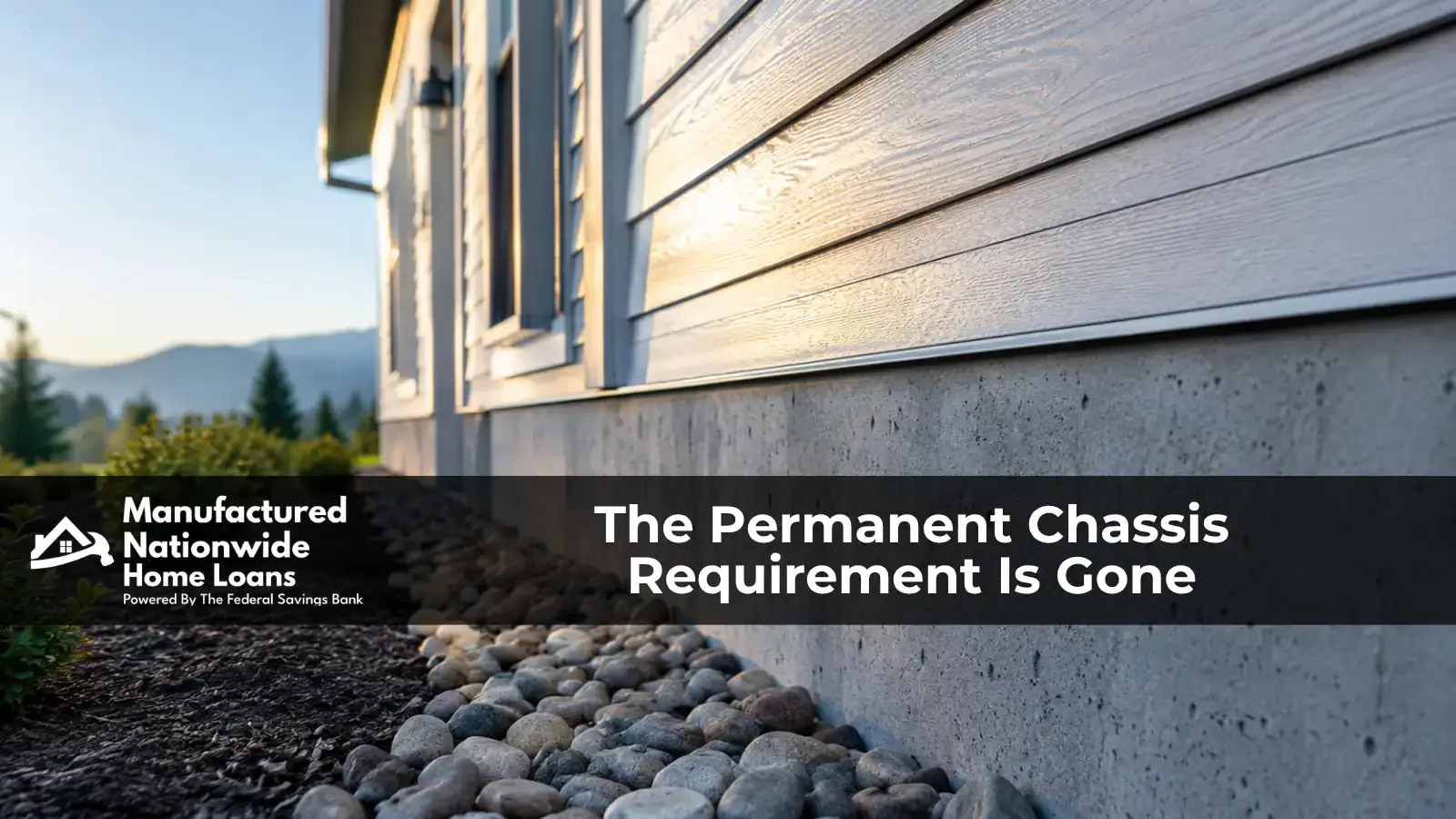
The Permanent Chassis Requirement Is Gone
This is the headline change, and it is bigger than it sounds.
What the old rule did
Since the HUD Code was written in the 1970s, a manufactured home has been defined in part by the presence of a permanent steel chassis. The frame the home was transported on had to stay attached forever, even after the home was set on a permanent foundation and would never move again.
That single requirement created a chain of consequences. It added cost and weight. It capped floor plan and roofline design. It kept manufactured homes visually distinguishable from site built homes in ways that fed appraisal discounts, zoning objections, and lender overlays. Buyers who wanted a home that looked and lived like a site built home were routinely steered toward stick built construction for reasons that were structural in name only.
What the new rule does
The Housing Supply Expansion Act inside Title III broadens the federal definition of a manufactured home to include a dwelling built with or without a permanent chassis. HUD is directed to establish the standards, labels, and documentation needed so chassis free homes are clearly identified as what they are.
In practice, a factory can now build a HUD Code home designed from the start to be delivered and permanently affixed to a foundation without carrying a steel frame underneath it for the rest of its life. The factory efficiency stays. The transport limitation eases. The design ceiling lifts.
Appraisal comparability. An appraiser values a home against comparable sales. When manufactured homes are visually and structurally set apart from everything around them, the comparable pool shrinks and values get discounted. That discount feeds loan-to-value, and loan-to-value feeds approval.
Lender overlays. Most lenders never wrote a rule saying manufactured homes are worse. They simply piled restrictions on top of federal guidelines because the collateral felt unfamiliar. Overlays are why so many borrowers hear no from a bank that technically offers the program.
Local zoning. Ordinances restricting manufactured home placement often lean on appearance standards. A chassis free HUD Code home built to look like its neighbors is a much harder home to exclude.
- HUD must publish the standards, labels, and documentation for chassis free homes
- Your state must certify equal treatment under its own laws
- Factories must build them, and appraisers must develop comparable sales data
This is a multi-year shift, not an overnight one. What it is not is theoretical. The legal barrier that held it back is now gone.

Every State Now Has a Deadline, and This Is the Part Nobody Is Talking About
Federal law can define a manufactured home. It cannot, by itself, tell your county assessor how to tax one or tell your state how to title one. Those are state functions, and they are exactly where manufactured housing has historically gotten stuck.
The law addresses this head on. Within one year of enactment, states must certify that their laws and regulations treat chassis free manufactured homes the same as traditional manufactured homes. States whose legislatures meet only every other year get two years.
| Area of State Law | Why It Matters to a Buyer or Owner |
|---|---|
| Financing | Determines whether lenders can treat the home as real property and offer standard mortgage products |
| Title | Governs whether the home stays titled like a vehicle or converts to real property with the land |
| Insurance | Affects whether standard homeowners coverage is available or only specialty policies |
| Manufacturing | Controls whether factories can legally build the home for sale in that state |
| Sale | Determines whether retailers and dealers can legally sell the home |
| Taxes | Decides whether the home is assessed as personal property or as real estate |
| Transportation | Sets the permits and requirements for moving the home to the site |
| Installation | Sets foundation, anchoring, and set standards for placing the home |
The consequence of inaction is real. If a state does not certify compliance, chassis free manufactured homes may not be manufactured, installed, or sold in that state. That is a genuine incentive for legislatures to act, and it means the map of where these homes are available will be drawn state by state over the next 24 months.
If you want to understand what your state requires of a manufactured home for financing purposes today, our guide to VA manufactured home requirements, federal and state rules, walks through foundation, title conversion, and appraisal standards as they currently exist.

Modular Homes Finally Get a Federal Definition
Modular homes have lived in a strange legal gap for decades. They are built in a factory, but to state and local building codes rather than the federal HUD Code. Legally they are site built homes that happen to be assembled indoors. Lenders, appraisers, and underwriters have never had a clean federal reference point for them.
The Modular Housing Production Act inside Title III defines a modular home in federal law as a factory built dwelling constructed in one or more modules, built to applicable state and local codes, transported to the site, placed on a foundation, and completed there.
Then it does something more useful than a definition. It directs HUD to review FHA construction financing programs specifically to identify the barriers modular developers run into, and to open a rulemaking to reduce them. It also allows HUD to fund a study on whether a standardized national modular code would help.
Construction financing is where modular has always broken down. A builder needs draws. A factory needs a deposit before it starts and payment before it ships. Traditional draw schedules were designed around a stick built home rising slowly on a lot, not a finished home arriving on a truck. Getting HUD to formally examine that mismatch is a real step.
We already finance factory built construction with a true one time close construction loan for manufactured and modular homes. Land and home are financed together in a single closing, with in-house construction management and a draw process built around how factories actually operate, not a brokered handoff to someone who has never funded one.
- Finance the land and the factory-built home together in one closing
- Manage construction draws in-house rather than brokering the loan out
- Work with your builder or dealer on the deposit and delivery schedule
- Close 30 to 60 days faster with an approved builder
See our one time close construction loans for manufactured and modular homes.

FHA Title I Gets Higher Limits and Longer Terms
FHA Title I is the federal loan program built specifically for manufactured homes, including home only financing where the borrower does not own the land underneath. For years it has been criticized as underused, with limits that drifted far behind what manufactured homes actually cost.
The Property Improvement and Manufactured Housing Loan Modernization Act does four things.
Higher loan limitsTitle I manufactured housing loan limits are increased, answering the long-standing complaint that program ceilings no longer matched what manufactured homes actually cost.
Longer loan termsLonger available terms are intended to make monthly payments more manageable for buyers previously priced out by short amortization.
ADUs become eligibleAccessory dwelling unit construction is added as an acceptable use for FHA insured property improvement loans, opening a federally insured path to a second unit on land you already own.
Off-site construction studyHUD must study the cost effectiveness of off-site construction techniques, a quiet signal about where the agency expects ADU and infill building to go.
The New FHA Small Dollar Mortgage Pilot Nobody Is Connecting to Manufactured Housing
Outside Title III sits a provision that may end up mattering to manufactured home buyers as much as anything inside it.
The law authorizes HUD to create a pilot program expanding access to FHA mortgages of $100,000 or less, including lender incentives, technical assistance, adjustments to FHA mortgage terms and costs, and grants for borrowers. HUD must establish the program within one year of enactment.
Why does that matter here? Because the small dollar mortgage market is where manufactured housing lives. A large share of manufactured homes fall below the price point at which a conventional mortgage originator can make the economics work. That gap is precisely why so many manufactured home buyers end up in personal property lending instead of a real estate mortgage, often at a materially higher cost.
Congress also directed the Consumer Financial Protection Bureau to study loan originator compensation practices and the points and fees thresholds that make small mortgages unattractive to originate. That is the plumbing underneath the problem, and it is now under formal federal review.

Zoning, Land Use, and Where Homes Are Allowed to Go
Placement restrictions are the second half of the manufactured housing problem. A home can be affordable, well built, and fully financeable, and still be illegal to put on the lot you just bought.
The law takes an incentive based approach rather than a preemption approach. Read that twice, because it is the most commonly misunderstood part of the bill. Congress did not override local zoning. It did this instead.
HUD will publish voluntary zoning and land use guidelines
HUD must create best practice frameworks for state and local zoning, developed with a task force of urban planners, developers, community members, researchers, public housing agencies, and state officials, then published in the Federal Register for public comment. The four categories are reducing zoning barriers, speeding up approvals, allowing more and alternative types of homes, and supporting development near transit.
Competitive planning grants begin next year
A grant program for states, cities, counties, and regional planning agencies will fund zoning code updates, housing plans, inspection capacity, and regulatory reform. Notably, the money cannot be used for construction, alteration, or repair. It is for changing the rules, not pouring the slab.
Pattern books and a $200 million Innovation Fund
Grants will help local governments adopt pre-reviewed housing designs, sometimes called pattern books, so smaller scale housing can be permitted faster. A separate $200 million annual Innovation Fund rewards local governments that demonstrably increase housing supply through zoning reform, by-right approvals, and reduced construction costs.
A city that wants to keep manufactured homes out can still decline the grant money and keep its ordinance exactly as written. Nothing in this law forces a local government to allow anything.
What changes is the incentive structure, and the existence of a federal best practice document that a homeowner, builder, or advocate can bring to a planning commission meeting. That is meaningful. It is also slow, and anyone telling you your local zoning problem was solved in June is selling something.

The PRICE Act: Preserving the Communities That Already Exist
Roughly 22 million Americans live in manufactured homes, and a large share of them live in manufactured housing communities. Those communities are among the most affordable unsubsidized housing in the country, and they have been under acquisition pressure for years.
The law reauthorizes PRICE grants, short for Preservation and Reinvestment for Community Enhancement, for seven years. Eligible uses include community infrastructure improvements, home replacements, accessibility enhancements, relocation assistance, and eviction prevention.
This is the preservation side of the ledger. Building new supply matters. So does not losing the affordable supply that already exists.
Ready to buy? See the best loans for manufactured homes and match the right FHA, VA, USDA, or conventional program to your plans.

Wall Street Is Now Restricted From Buying Single Family Homes
This provision drew the most mainstream coverage, and it deserves an accurate explanation rather than a celebratory one.
Title X restricts additional purchases of single family homes by corporations, private equity firms, real estate investment trusts, and similar entities that hold 350 or more single family homes. Beyond being barred from acquiring more, large investors are also required to reduce their holdings over time, which is intended to return inventory to the broader market. HUD is directed to establish a renter outreach resource to help tenants of investor-owned homes navigate landlord disputes.
- Nonprofit organizations
- Public agencies
- Builders
- Mortgage holders
- Entities temporarily holding homes for redevelopment, foreclosure, or resale
- Investors purchasing or building new homes specifically for the rental market, subject to conditions
On the manufactured housing question. The Manufactured Housing Institute, the industry's national trade association, has stated publicly that the law's institutional investor provisions were drafted so manufactured housing is not inadvertently captured by restrictions aimed at large single family home investors. Exactly how that works in practice depends on how the restriction is implemented and enforced. We will update this page as federal guidance is issued rather than speculate now.
For an individual buyer, the practical read is simpler. Fewer institutional cash offers competing for entry level homes should, over time, mean a less brutal environment for a family trying to buy one house to live in. That is the intent. Whether it delivers is an empirical question that will take years to answer.

What Has to Happen Before Any of This Reaches Your Lender
This is the section most articles skip, and it is the one that will save you a frustrating phone call.
A law being enacted does not change what a loan officer can approve tomorrow. Here is the sequence that has to run first.
| Step | What Happens | Realistic Timing |
|---|---|---|
| 1. Agency rulemaking | HUD writes the actual rules: chassis free home standards, labeling, documentation, energy standards, and revised Title I parameters | Months to years, with public comment periods |
| 2. State certification | Each state certifies that its financing, title, insurance, tax, transport, and installation laws treat chassis free homes equally | One year, or two for biennial legislatures |
| 3. Program guidance | FHA issues mortgagee letters and handbook updates so lenders know exactly how to originate and insure under the new parameters | Follows rulemaking |
| 4. Investor adoption | Loan purchasers, insurers, and the secondary market update their own requirements | Follows guidance |
| 5. Lender implementation | Individual lenders update underwriting guidelines, systems, and overlays | Follows everything above |
Anyone telling you that a new loan limit or a chassis free home is available to finance today is getting ahead of the process. We would rather tell you the truth and keep your trust.
What we can tell you is that we have been financing manufactured, modular, and mobile homes in all 50 states for years, in-house, and that the programs available to you right now are considerably better than most borrowers have been led to believe.
What You Can Actually Do Today
Most lenders either decline manufactured housing outright or bury it under restrictive overlays. We built our business on the opposite position. Manufactured and modular homes are a legitimate, high quality, dramatically more attainable alternative to site built construction, and we underwrite them that way.
Finance the land and the factory-built home together in a single closing, with in-house construction management and draws handled by people who have actually funded factory builds. Approved builders can close 30 to 60 days faster.
Best if: you are building new on land you own or are buying at the same time. See manufactured and modular construction loans.
Purchase a manufactured or modular home with as little as 3.5% down, with flexible credit standards and an in-house loan committee rather than a rigid overlay.
Best if: you are a first-time or credit-building buyer. See FHA manufactured home purchase loans.
Eligible Veterans can purchase a manufactured or modular home with no down payment and no monthly mortgage insurance, land and home together.
Best if: you are a Veteran, active duty, or an eligible surviving spouse. See VA manufactured home purchase loans.
Zero-down financing on eligible rural properties for manufactured and modular homes, a program most lenders will not touch on factory-built collateral.
Best if: your property sits in an eligible rural area. See USDA manufactured and modular home loans.
Access the equity in a manufactured home you already own through a VA or FHA cash-out refinance, or through a second lien that leaves your existing first mortgage rate untouched.
Best if: you need a large sum. See VA cash-out, FHA cash-out, or manufactured home equity loans.
Lower your rate without an appraisal or full income documentation through a VA IRRRL or an FHA streamline, even if you owe more than the home is worth.
Best if: you simply want a lower payment. See VA IRRRL or FHA streamline refinance.
Lends against what your home will be worth after the improvements are complete, not what it is worth today, so you can renovate even at a high loan-to-value.
Best if: the money is going into the home itself. See manufactured renovation loans.
Conventional and portfolio financing, VA jumbo for higher-value homes and large acreage, and second home scenarios most lenders decline outright on factory-built collateral.
Best if: your scenario does not fit a standard box. See all loan programs or all Jumbo loan programs on our sister site.
Not sure where you fit? Start with our manufactured home mortgage calculator to estimate a payment and cash to close, or read how to find the best loan for a manufactured home.
Up to $50,000 in Additional Funds, Without Touching Your Equity
Congress has now directed federal regulators to study why small dollar lending is so hard for ordinary borrowers to get. We already built a working answer. Qualified borrowers can access up to *$50,000 in separate, unsecured funds, underwritten in-house alongside your mortgage. It does not touch your home equity, your loan-to-value, or your rate, and it works even when you have no equity at all. Finish the build, complete the site work, furnish the home, or consolidate debt. No other lender in this space offers it.
See if you qualify for the extra $50,000 alongside your manufactured or modular home loan.
Check Your Eligibility*Qualification for up to $50,000 is for qualified borrowers and can be applied to all loan programs. This is a separate unsecured consumer loan underwritten in-house at the same time as your mortgage. Proceeds cannot be used for a down payment. Contact your banker for applicable rates, terms, and conditions.
Frequently Asked Questions
When did the 21st Century ROAD to Housing Act become law?
July 11, 2026. The bill passed the Senate 85 to 5 and the House 358 to 32 in late June 2026 and was presented to the President on June 29. Because it was neither signed nor vetoed within the constitutional window, it became law automatically.
Does the law mean manufactured homes no longer need a chassis?
The federal definition of a manufactured home now includes homes built with or without a permanent chassis. HUD must still establish the standards, labels, and documentation for chassis free homes, and states must certify equal treatment under their own laws, before these homes can be built, installed, and sold in a given state.
Are FHA manufactured home loan limits higher right now?
No. The law directs increases to FHA Title I manufactured housing loan limits and longer loan terms, but those take effect through HUD implementation. The limits that apply to a loan today are today's published limits. You can review current limits on our county loan limits page.
What happens if my state does not certify compliance?
If a state does not certify within one year, or two years for legislatures that meet biennially, chassis free manufactured homes may not be manufactured, installed, or sold in that state. Traditional manufactured homes are unaffected by that outcome.
Does the law stop investors from buying manufactured homes?
The law restricts large institutional investors that own 350 or more single family homes from acquiring additional single family homes, with exemptions for nonprofits, public agencies, builders, mortgage holders, and entities temporarily holding homes for redevelopment, foreclosure, or resale. The Manufactured Housing Institute has stated that the provisions were drafted so manufactured housing is not inadvertently captured. Implementation details will come from federal guidance.
Can I use an FHA loan to build an ADU now?
The law adds accessory dwelling unit construction as an acceptable use for FHA insured property improvement loans. As with the other provisions, this becomes available to borrowers once HUD implements it and lenders update their guidelines. If you are looking at an ADU or an addition today, our renovation loan programs and the $50,000 consumer loan are the current paths.
Will this make manufactured homes appraise higher?
Not immediately, and not by decree. Appraised value comes from comparable sales. As chassis free HUD Code homes are actually built and sold, appraisers gain the comparable data that has historically been missing. That is a multi-year process, and nobody can promise a specific outcome from it.
Does the law give me money to buy a home?
No. The law does not appropriate new funding. It changes definitions, directs federal agencies to act, and creates grant frameworks that Congress would have to fund separately. Do not make a purchase decision based on an expectation of a federal check.
What is the PRICE Act in the ROAD to Housing Act?
PRICE stands for Preservation and Reinvestment for Community Enhancement. The law reauthorizes these grants for seven years to fund repair, preservation, and improvement of manufactured homes and manufactured housing communities, including infrastructure, home replacements, accessibility work, relocation assistance, and eviction prevention.
What manufactured home financing can I actually get today?
FHA, VA, USDA, and conventional purchase financing for manufactured and modular homes, one time close construction loans, cash-out and streamline refinances, home equity access, and renovation loans, in all 50 states. Eligibility depends on credit, income, property, and program guidelines. Start with our eligibility check.
Official Sources and Further Reading
- Full bill text of the 21st Century ROAD to Housing Act, H.R. 6644, United States Senate Committee on Banking, Housing, and Urban Affairs
- Sprawling Federal Housing Reform Bill Becomes Law, National Conference of State Legislatures, July 10, 2026
- Inside the Deal: What's in the Final 21st Century ROAD to Housing Act, Bipartisan Policy Center, section by section summary
- U.S. Department of Housing and Urban Development, the agency responsible for implementing Title III
- Consumer Financial Protection Bureau, directed to study small dollar mortgage barriers
This page will be updated as HUD issues rulemaking and as states begin certifying. More manufactured housing guides are available in our education and resource center.
Explore More Manufactured and Modular Programs
Building new? See our one time close construction loans for manufactured and modular homes. Buying? Start with FHA manufactured purchase, VA manufactured purchase, or USDA manufactured home loans. Already own? Look at VA cash-out, FHA cash-out, manufactured home equity loans, or manufactured renovation loans. Lowering a rate? See the VA IRRRL streamline or the FHA streamline refinance. See everything on our manufactured home loan programs page, or browse our education and resource center.
Get Answers Before the Rules Change
You do not have to wait for HUD to write a rule to find out what you qualify for today. Tell us what you are trying to do, buy, build, refinance, or pull cash, and we will tell you honestly what is possible right now, and what is worth waiting for. We are the lender, not a lead form, and we underwrite manufactured and modular homes in all 50 states.
- Best Manufactured Home Lender, Investopedia
- Best Overall Construction Lender, Investopedia
- Best VA Construction Lender, Investopedia
- Top Mortgage Workplaces, Mortgage Professionals Association
- Top Rated Local Winner, 2019 and 2020
- Featured in national publications and broadcast
- As Featured InInvestopedia, The Mortgage Reports, Military.com, BobVila.com, Military Makeover with Montel
This article is provided for general educational and informational purposes only and reflects publicly reported information about the 21st Century ROAD to Housing Act as of July 14, 2026. It is not legal, tax, or financial advice, and it is not a commitment to lend or an offer of credit. Provisions described in this article require federal agency rulemaking, program guidance, and in some cases state legislative action before they take effect, and their final form may differ from what is described here. Loan program availability, terms, and limits are subject to change and depend on applicant credit qualification, income, property eligibility, program guidelines, and applicable law. Not all applicants will qualify. ManufacturedNationwide.com is powered by The Federal Savings Bank, NMLS# 411500. Member FDIC. Equal Housing Lender.